Among the countless treasures of antiquity, few concepts have been as widely misunderstood and misappropriated as Platonic love (Koine Greek: πλατωνικὴ ἀγάπη; Platonike Agape). This philosophical treasure, extracted from the dialogues of Plato, has journeyed far from its origin, shedding fragments of its meaning across centuries and cultures. Today, it is often trivialized as the antithesis of physical passion, a refined affection divorced from desire. Yet, to those who delve into the writings of the Athenian master, the truth emerges—a vision of love not as negation but as excellence, a rise toward the eternal and incorruptible essence of beauty itself.
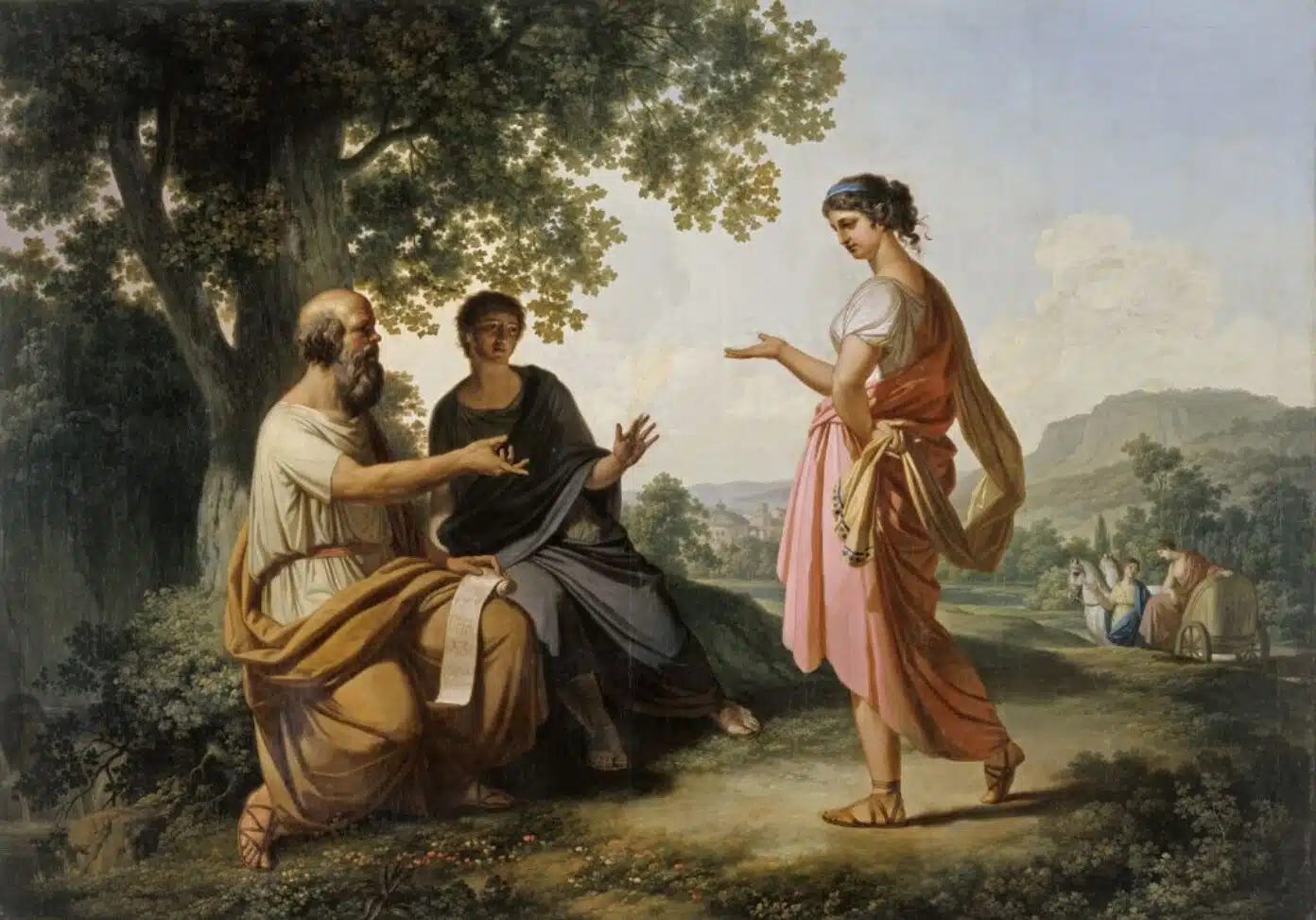
To comprehend Platonic love, one must turn to Plato’s Symposium, that luminous banquet of ideas where the great men of Athens gathered not merely to drink but to unravel the mysteries of Eros. Within the dialogue, Socrates recites the teachings of Diotima, a priestess of Apollo, who reveals love as a progression, a series of ascending steps guiding to the ultimate concern of beauty.
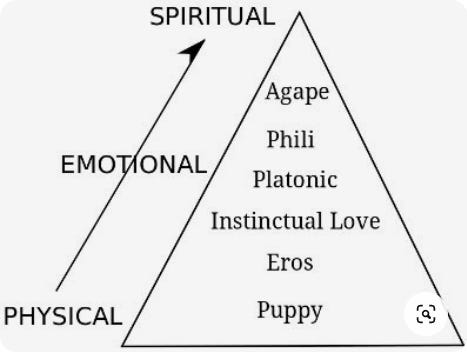
To clarify the steps of Diotima’s Ladder, we must express the philosophical ascent from the physical to the spiritual, from the temporary to the everlasting. Each step elevates the lover’s understanding of beauty, transforming desire into a profound pursuit of truth, virtue, and ultimately, the divine essence of reality.
Physical Attraction
The journey starts with an attraction to physical beauty. Plato acknowledges the sensory appeal of physical form as a natural and necessary beginning. It represents love in its most accessible form, where the harmony and symmetry of a person’s appearance captivate the observer. This step is not overlooked but is valued as the foundation for more elevated pursuits.
Multiplicity of Forms
As the lover matures, they begin to see beauty in various forms rather than in a single individual. This step widens the perspective of the lover, allowing them to perceive beauty as a shared quality, not limited to one entity but present in many. This conception marks the first movement from the particular to the universal.
Beauty of the Soul
Here, love transcends the physical and embraces the moral and intellectual virtues of another. This phase values inner qualities—kindness, wisdom, and integrity—over outward appearances. The lover begins to appreciate the essence of a person’s character, leading to a deeper, more enduring bond.
Moral Beauty
At this stage, love inspires the pursuit of ethical excellence. The lover is drawn to individuals who embody virtue, encouraging a commitment to developing goodness in themselves and others. Beauty becomes intertwined with moral ideals, reflecting Plato’s belief that love and virtue are naturally attached.
Intellectual Beauty
The focus shifts to the beauty found in knowledge, governance, and societal structures. This step emphasizes the harmony and order within intellectual and social constructs, such as laws and ideas that elevate human life. Love here becomes an appreciation of wisdom and its applications.
The Beauty of Knowledge
At this point, beauty is sought in truths demonstrated through science, philosophy, and reason. The lover finds joy in intellectual pursuits, where understanding and insight become sources of profound fulfillment. This step mirrors the alignment of rational thought with the pursuit of beauty.
The Form of Beauty
The final and ultimate stage is the contemplation of Beauty itself—an eternal, perfect, and unchanging ideal. This metaphysical vision transcends all particular images of beauty. It aligns with Plato’s theory of Forms, where the lover ascends to perceive Beauty as a pure, conceptual essence. This conclusion conveys the ultimate goal of the soul: union with the divine through the appreciation of the Good.
Platonic Love, the Ideal World, and The Allegory of the Cave Revisited
Plato’s metaphysical hierarchy of love serves as a mirror to his belief in the exceeding world of Forms (Attic Greek: Ἰδέα, Idea), the eternal archetypes that exist beyond the cover of material reality. In this realm, every brief and imperfect manifestation in the physical world is but a shadow, a dim reflection of its pure and immutable ideal.
Far from a surrender of desire, Platonic love demands its refinement, its purification. It is not a negation of passion but an alchemical transformation, a redirection of its fire toward the sublime. The stirrings awakened by physical beauty, though vivid, are but a faint reminder of the soul’s yearning for the divine. For what is beauty if not a worldly intimation of something greater, a cipher indicating a realm where perfection is not simply imagined but exists in its fullest presence?
Plato’s Allegory of the Cave offers a parallel. Within the cave, those bound by chains see only blinking shadows, mistaking them for the fullness of reality. Their captivity is not merely physical but epistemological—a failure to perceive the truth that lies beyond appearances. So it is with love: those who restrict themselves to the corporeal are trapped by illusion, fixated on the forms of the material. They remain tethered to shadows, unable to capture the Form of Beauty itself.
To ascend is to liberate the soul from its shadowed prison. It is to step beyond the mutable, to leave behind the vague reflections, and enter the realm of light where the eternal resides. Here, love achieves its apotheosis, becoming not an ephemeral desire but a reflection of the divine, a communion with the inexpressible. Plato’s vision is nothing less than revolutionary—a call to top the base and ephemeral, to recognize in the beloved a gateway to the everlasting.
The Perspective of Aristotle and Others
While Plato’s philosophy elevates love to the realm of the transcendent, his student Aristotle provides a more grounded counterpoint. In his Nicomachean Ethics, Aristotle contrasts three types of friendship: friendships of utility, pleasure, and virtue. The highest form, akin to Platonic love, is based on mutual respect and the shared pursuit of the good. Unlike Plato’s stress on abstraction, Aristotle situates love within the context of human relationships and community.
The Stoics, too, offer their insights. For figures like Epictetus and Marcus Aurelius, love was bound to the concept of universal reason, logos. To love another was to recognize their role within the related web of existence, a sentiment that resonates with Plato’s vision of unity through beauty.
Through Plato’s words, we are reminded that love, in its highest form, is not merely a feeling but a force—a transformative power that drives the soul toward the eternal light of truth and beauty. Let us, then, rediscover the true essence of Platonic love, and in doing so, awaken to the sublime possibilities that lie within our reach.
In a world that often reduces love to fleeting passion or pure affection, the Platonic ideal remains a beacon of what could be—a call to refine, to see beauty not as an object to possess but as a pathway to wisdom and the divine. The question, dear reader, is whether you will take that first step on Diotima’s ladder, and if so, how far you will dare to climb.
As all things must, we have arrived at the end of this article, and I am compelled to share with you some rather unfortunate news as I did in Roxburghe Club Jr. earlier. It seems that Stripe has decided that my association with their enterprise must now come to an end. No reasons were given, no explanations offered to me—as silent and immovable as a marble tomb. Yet, that is a burden I shall bear alone.
More importantly, what concerns us here is not the closing of one door but the opening of another. I am pleased to announce that I have made memberships available on my Buy Me a Coffee account, a platform where generosity flows safely and easily. Supporting my work is now simpler than ever, whether with a one-time contribution starting at a modest $5, or by joining as a Guardian of the Printed World or Knight of the Round Table for a monthly membership beginning at $10.
Your generosity sustains the scholarship and vocation to which I have devoted my life. To those who choose to walk this path with me, my deepest thanks—for your kindness is not merely a gesture, but a foundation upon which I build my craft and continue to explore the boundless world of ideas. Here are the details with a URL to my page: